

You’ll need one portable toilet per 50-75 guests for most Orlando events; however, Florida’s health regulations require stricter ratios depending on your specific situation. Construction sites must provide one unit per 10 workers, while festivals need one per 75-100 attendees for short events. If you’re serving alcohol, increase your count by 25-40% since usage jumps considerably. ADA compliance mandates 5% wheelchair-accessible units, and longer events require extra facilities to maintain sanitary conditions throughout your gathering.
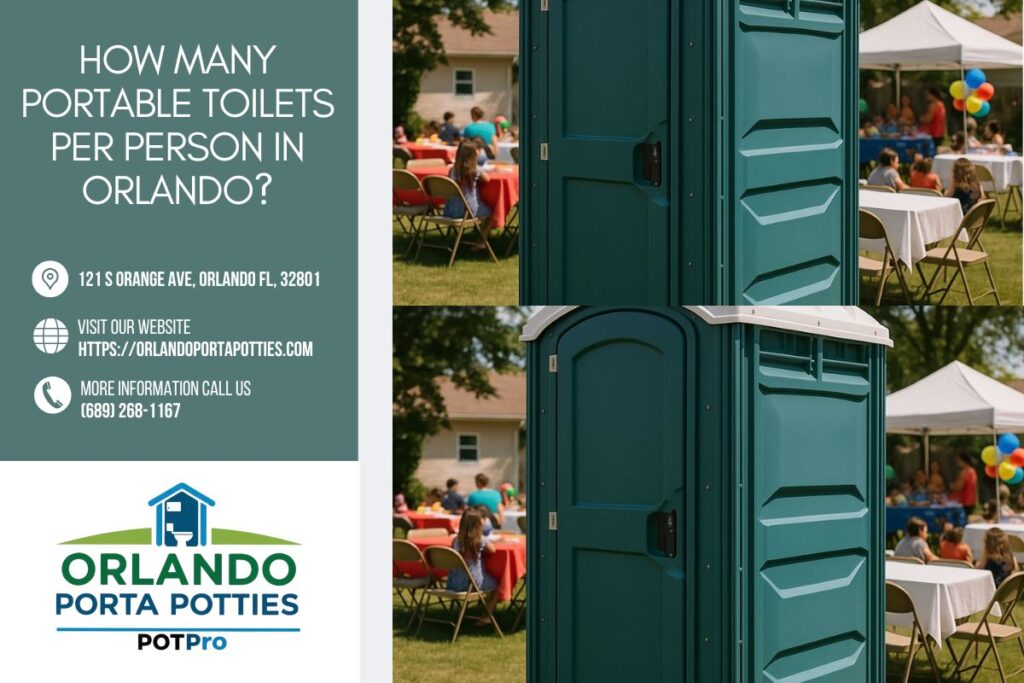
When planning portable restroom requirements for your Orlando event, OSHA and health department regulations establish baseline ratios of one porta potty per 10 workers for construction sites lasting more than 24 hours.
However, you’ll need different ratios depending on your specific situation. For outdoor festivals and public gatherings, health departments typically recommend one unit per 75-100 attendees for events lasting four hours or less, increasing to one unit per 50 people for events lasting longer than four hours.
Wedding receptions typically require one portable toilet for every 50-75 guests, while corporate outdoor events normally need one unit for every 40-60 participants.
These ratios guarantee compliance with sanitation standards while maintaining guest comfort. You’re free to exceed these minimums for improved convenience, but falling below regulatory requirements can result in health violations and event shutdowns.
See also: portable toilet rental service in Orlando
Multiple regulatory bodies have established specific porta potty requirements that vary considerably between construction sites and special events in Orlando.
OSHA mandates one toilet for every 20 workers on construction sites, with hand-washing facilities required within 200 feet.
You’ll find that Florida’s Department of Health requires stricter ratios for food service events—one unit per 75 attendees for gatherings of four hours or less, increasing to one unit per 50 attendees for longer events.
The International Code Council sets baseline standards that Orlando municipalities often exceed.
You’re legally required to provide ADA-compliant units comprising 5% of your total rental for public events.
These regulations aren’t suggestions—they’re enforceable health codes designed to prevent the transmission of disease and maintain sanitary conditions.
Non-compliance results in fines, shutdowns, and potential liability for health violations affecting your workers or guests.
Beyond meeting baseline regulatory requirements, several key variables directly impact the number of portable toilets you’ll need for your Orlando project or event.
Duration considerably affects calculations—longer events require supplementary units as waste accumulates, and cleaning schedules become more critical. Gender ratios influence placement since women typically require 30% more restroom time than men. Alcohol service increases usage by approximately 40%, while food vendors elevate demand by 25%.
Weather conditions in Orlando’s humid climate accelerate waste breakdown and odor issues, necessitating the use of extra units during the summer months.
Event type matters too—active outdoor festivals generate different usage patterns than seated conferences. Accessibility requirements mandate ADA-compliant units for public events.
Your site’s layout and distance between units also determine ideal quantities, ensuring you’re not restricting attendees’ freedom of movement while maintaining sanitary conditions.
Different event types generate distinct restroom usage patterns that directly impact your portable toilet requirements in Orlando.
Construction sites require one unit per 10 workers for a 40-hour week, while festivals need increased ratios due to alcohol consumption and extended stays.
Wedding receptions typically need fewer units since guests alternate between indoor facilities and outdoor areas.
Duration significantly affects calculations. Single-day events use standard ratios, but multi-day festivals require 25% extra units due to cumulative usage.
Corporate events lasting 4-8 hours need baseline quantities, whereas overnight camping events demand improved ratios.
Health regulations mandate minimum standards: construction sites must provide facilities within 200 feet of work areas.
Food service events require handwashing stations alongside standard units to prevent contamination and maintain sanitary conditions for the well-being of your guests.
Event duration creates the most critical impact on portable toilet calculations, with short-term gatherings requiring fundamentally different approaches than extended events.
Short-term events lasting 4-8 hours typically require one unit per 50-75 people, since guests won’t consume multiple meals or beverages throughout the day. You’ll find this ratio sufficient for concerts, festivals, or sports events.
Multi-day events demand considerably more units—one per 10-15 people—because attendees consume more food and liquids over extended periods.
Health regulations emphasize the need for increased sanitation at overnight events, requiring the installation of additional handwashing stations and regular servicing. Extended exposure increases contamination risks, making adequate facilities vital for preventing illness outbreaks.
You can’t compromise on quantity when people depend on these facilities for days rather than hours.

Alcohol consumption dramatically increases portable toilet demands because alcoholic beverages act as diuretics, causing guests to use facilities 30-50% more frequently than at dry events.
You’ll need to increase your toilet count by 25-40% when alcohol’s served to maintain acceptable wait times and prevent unsanitary conditions.
Food service compounds this effect considerably. Events featuring high-sodium foods, spicy dishes, or extensive beverage options accelerate bathroom usage patterns.
Wedding receptions with full bars require one toilet per 40-50 guests, while beer festivals need one per 30-35 attendees.
You’re legally responsible for providing adequate facilities that protect public health.
Insufficient toilets create health hazards, violate local regulations, and damage your event’s reputation.
Calculate conservatively—undersupplying portable toilets restricts your guests’ comfort and the success of your event, while potentially exposing you to regulatory penalties.
Accurate portable toilet calculations require specific formulas based on your event’s attendance figures and duration.
You’ll need to adjust these baseline ratios according to the guidelines of the Orlando Health Department and the specific crowd characteristics.
Standard calculations follow these crucial ratios:
You’ll want to increase these numbers by 15-20% when alcohol’s served or food vendors are present.
Orlando’s regulations mandate maintaining these minimum standards to guarantee proper sanitation and guest comfort throughout your event.
Three distinct categories of gatherings require different planning approaches for portable toilets to meet the Orlando Health Department’s standards and ensure adequate sanitation coverage.
For small gatherings (under 150 people), one unit is required per 50 attendees for events lasting 4-6 hours.
You’ll maintain compliance while avoiding over-ordering, which can drain your budget.
Medium gatherings (150-750 people) require one unit per 75 people, with mandatory hand-washing stations.
Orange County regulations demand this improved ratio for events exceeding 4 hours.
Large gatherings (750+ people) need specialized calculations: one unit per 100 attendees, plus ADA-compliant units (minimum 5% of total).
You’re required to include luxury trailers for VIP areas and guarantee 24-hour maintenance access.
Each category requires strategic placement every 300 feet, at most, to prevent long walks that compromise sanitation effectiveness and attendee satisfaction.
High-traffic scenarios dramatically increase portable toilet demands beyond standard calculations, requiring one unit per 25-30 people when you’re hosting concerts, festivals, or sporting events where attendees consume alcohol or food.
Low-traffic events, such as construction sites or small outdoor meetings, can operate with one unit per 50-75 people, providing more flexibility in your rental budget.
Consider these traffic-specific factors:
You’ll prevent health code violations and ensure guest satisfaction by matching your rental quantity to actual traffic patterns, rather than relying on basic headcounts.
Orlando’s portable toilet regulations extend beyond basic traffic calculations to encompass strict health department mandates that must be followed to avoid fines and ensure public safety. Florida Administrative Code 64E-11 requires specific ratios for different event types. Construction sites need one unit per 20 workers for shifts exceeding four hours, while food service events require supplementary handwashing stations at a 1:3 ratio to standard units.
| Event Type | Required Ratio | Further Requirements |
|---|---|---|
| Construction Sites | 1 unit per 20 workers | Handwashing facilities mandatory |
| Food Service Events | 1 unit per 75 attendees | 1 handwashing station per 3 units |
| Public Gatherings | 1 unit per 100 people | ADA-compliant units required |
You’ll need permits for events with more than 200 attendees, and all units must meet accessibility standards under the Americans with Disabilities Act, which requires at least 5% of the facilities to be ADA-compliant.
Why do accessibility requirements matter so critically in portable toilet planning?
Federal ADA compliance mandates that you provide wheelchair-accessible units for at least 5% of your total portable toilet inventory. These specialized facilities must feature wider doorways (minimum 32 inches), an interior maneuvering space of 60 inches in diameter, and grab bars positioned 33-36 inches above the floor.
You’ll need ADA units that meet these specific criteria:
Orlando’s event permits often require accessibility documentation before approval.
You’re protecting your freedom to operate while guaranteeing everyone can participate in your event with dignity and independence.
Beyond event accessibility requirements, OSHA regulations establish mandatory portable toilet ratios that must be followed on construction sites to maintain worker health and ensure regulatory compliance.
You’re required to provide one toilet facility for every 20 workers or a fraction thereof when toilets aren’t reasonably accessible. These facilities must be available within a quarter-mile of the work area and maintained in sanitary conditions.
OSHA’s standards protect your workers from health risks associated with inadequate sanitation, including urinary tract infections and dehydration from delayed bathroom breaks.
Non-compliance results in citations, fines, and potential work stoppages that’ll cost you more than proper planning.
Competent contractors calculate ratios early, taking into account peak workforce periods and site accessibility challenges.
This proactive approach keeps your project moving while protecting worker welfare and your bottom line.
While regulatory minimums provide baselines, accurate portable toilet planning requires analyzing your specific event dynamics, workforce patterns, and site conditions to prevent undersupply emergencies.
You’ll need strategic assessment beyond basic calculations to maintain health standards and operational freedom. Consider these critical factors:
Factor in weather conditions, user demographics, and alcohol consumption for events. Document your planning rationale for regulatory compliance.
Orlando’s heat increases hydration needs, potentially requiring 15-20% more units than standard recommendations suggest.
Local Orlando providers possess specialized knowledge of municipal regulations, permitting requirements, and climate-specific challenges that significantly impact the accuracy of portable toilet planning.
You’ll find that Orlando’s humid subtropical climate necessitates enhanced sanitation protocols, prompting providers to adjust delivery schedules and maintenance frequencies beyond standard recommendations.
Local experts are familiar with Orange County’s specific permit requirements, which differ significantly from those of other Florida jurisdictions.
They’ll guide you through compliance with health department regulations, ADA accessibility mandates, and site-specific placement restrictions that impact the success of your event.
You gain access to real-time availability data, emergency response capabilities, and weather-contingent planning when you consult Orlando-based providers.
Their established relationships with local authorities streamline permit acquisition processes. At the same time, their climate-adapted inventory ensures top hygiene standards throughout Florida’s challenging weather patterns, protecting your guests’ health and your event’s reputation.
These online tools typically use national averages that don’t account for Florida’s heat-related factors or Orange County’s specific regulations.
You’ll find most calculators recommend elemental ratios without considering Orlando’s extended outdoor event seasons.
Essential calculator limitations include:
Cross-reference calculator results with Orlando’s municipal guidelines and consult local providers who are familiar with regional compliance standards for accurate planning.
Orlando’s Food & Wine Festival requires one portable toilet per 50 attendees, which doubles the standard ratio due to the extended event duration and alcohol service.
The EDC Orlando music festival implements one unit per 75 people, with supplementary handwashing stations every 150 feet.
Universal Studios’ Halloween Horror Nights maintains one portable toilet for every 100 guests in outdoor queuing areas, supplementing permanent facilities.
The Orlando City Soccer Club uses one unit per 200 attendees for tailgating events.
You’ll notice these ratios prioritize health compliance over cost savings, ensuring adequate sanitation access without government interference in your event planning decisions.
Different event types demand specific portable toilet ratios based on health department guidelines and attendee behavior patterns.
You’ll need different calculations depending on the nature and duration of your event in Orlando.
Event-Specific Ratios:
These ratios guarantee compliance with Orange County health regulations while maintaining guest comfort.
While public park gatherings and private parties might seem similar, they require distinct portable toilet calculations based on Orange County’s public health ordinances and facility access limitations.
For public park events, you’ll need one portable toilet per 75-100 attendees when permanent facilities aren’t accessible. Orange County regulations mandate this ratio to prevent unsanitary conditions that compromise public health freedom.
Private parties on residential properties require more units—one per 50-75 guests—since you’re solely responsible for waste management without municipal backup systems.
Duration matters considerably: gatherings exceeding four hours require additional units, regardless of initial calculations.
Consider alcohol service, which increases usage by 20-30%. You’re protecting your guests’ comfort while ensuring compliance with local health codes that maintain sanitary conditions for everyone.
If you run out of portable toilets, you’ll face health code violations, unsanitary conditions, and a potential event shutdown. You’re risking attendee safety and your reputation. Contact us immediately—we’ll deliver emergency units to maintain compliance and protect everyone’s health.
You’ll need portable toilet servicing every 2-3 days during multi-day events to maintain health standards and prevent overflows. Daily servicing is recommended for high-traffic events to ensure your guests’ comfort and compliance with Orlando’s sanitation regulations.
You can relocate portable toilets during events, but you’ll need proper equipment and planning. Consider safety regulations, accessibility compliance, and sanitation requirements. Moving units can temporarily disrupt service, so coordinate relocations during low-usage periods for an optimal guest experience.
You’ll typically pay 20-40% more for premium units that feature hand sanitizer dispensers, improved ventilation, and upgraded interiors. Standard units meet basic sanitation requirements, while premium options improve user comfort and hygiene compliance for your event.
Standard portable toilets don’t require electricity or water hookups—that’s their freedom advantage. However, you’ll need power connections for premium units with handwashing stations, lighting, or climate control features to meet improved sanitation standards.




© 2026 Orlando Porta Potties | PotPro. All Rights Reserved.